
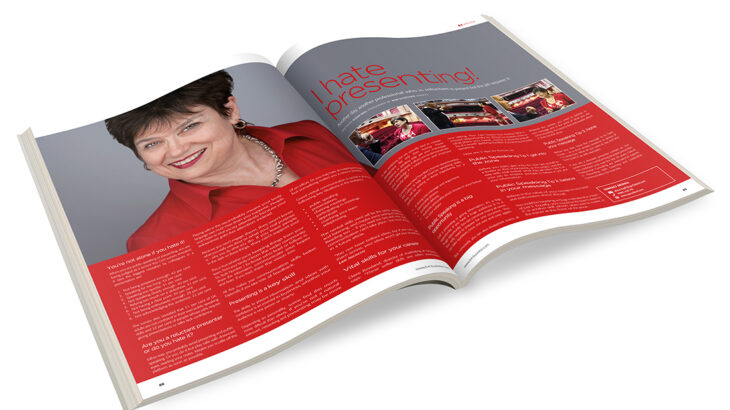
Another day, another professional who is reluctant to present but the job requires it.
Written by Alison Haill
You’re not alone if you hate it!
When you are public speaking or presenting, you are being judged as a recent You Gov survey revealed. It says the biggest mistakes by colleagues in a presentation are:
1. Not being prepared enough: 42 per cent
2. Speaking for too long: 42 per cent
3. Speaking too quickly: 41 per cent
4. Not speaking clearly enough: 40 per cent
5. Relying too much on a slideshow: 31 per cent
6. Not having a clear point: 30 per cent
7. Not being enthusiastic enough: 29 per cent
8. Not acknowledging the audience: 22 per cent
The survey also revealed that 51 per cent of UK adults are not confident in their own public speaking skills and 22 per cent of people whose jobs require giving presentations or talks lack confidence.
Are you a reluctant presenter or do you hate it?
Either way, you probably avoid presenting and public speaking. Or you do it but play safe with downcast eyes, reading your notes. Maybe you scuttle off the platform as soon as possible.
Playing safe in this way probably means your body language says much more than you suppose. People won’t listen to what you say attentively because your awkwardness grabs their attention instead.
Because you won’t engage them, they won’t know what you really care about or what your real purpose is – why you do what you do. If you leave people in the dark on these things, they can’t support you!
This is true whether you’re keeping things from your team, from your family or from the wider community. So, Rule Number 1 for those who lead or follow is: share the information, communicate your hopes and fears. If you lead, share the vision too.
All this makes your communication skills better. Especially if you take note of feedback.
Presenting is a key skill
The ability to present information and ideas with confidence is an essential in business, whether your audience is one person or many.
Depending on personality, some find this much more difficult than others. If you’re not a natural extrovert, networking and presenting may be more of an effort. Or you may have an outgoing personality but something makes you a nervous presenter.
Good verbal communication is central in all of the following key situations in the workplace:
• public speaking
• presentations
• chairing meetings
• participating in meetings
• appraisals
• coaching your team
• telephoning
The central skills used will be the same: speaking and listening, and maybe some writing as back-up. Reading too – if you read too fast and miss stuff, communication can’t take place – but more of that in a future article.
“You can have brilliant ideas, but if you can’t get them across, your ideas won’t get you anywhere.”
Lee Iacocca
Vital skills for your career
Claire Rowland, director of marketing at QHotels,says: “These softer skills are often overlooked in the workplace, but are actually vital in career development. Not only does having more confidence in speaking help get your message across more effectively, it allows you to demonstrate your knowledge in a subject area and improve leadership skills.”
Q Hotels have hired Tony Blair’s former speechwriter, Phil Collins, to help staff improve speaking skills. They will be working on these ingredients for aperfect speech:
• A strong core message and argument,
• Memorable phrases
• Confident delivery,
• Authentic personality which shows in your belieffor your subject
Public Speaking is a big opportunity
Call it presenting or giving information, it’s a big opportunity. If you have a huge audience it is a huge opportunity. You can convince many at once. You only need to prepare for one occasion. You can take questions once, not over and over again.
But, conversely, you can also disappoint many atone sitting. You can leave them thinking “What a missed opportunity to dispel our anxieties, show uswhat plans you have, excite us about the project!”So it’s worth getting better at presenting and publicspeaking.
Here are 3 tips to focus on:
Public Speaking Tip 1: get into the zone
Before you start, get into the zone. See yourself asa leader in this moment, on this subject. Lead the way with real belief and they will follow. See it as your job to inspire people to believe in you and your information.
Public Speaking Tip 2: believe in your message
Believe in the value of your message: let your belief and enthusiasm shine through.
You could be heading a huge multinational or a team of just 3. Equally, you could be the team’s expert in IT or another skill which others want to master, or the trainer at the front of the group.
Whatever the context, you need to believe in your message and in the point of what you are communicating. You need to feel enthusiastic about it. Then let that show.
Public Speaking Tip 3: hone your message
Before you start, hone the message to its bare bones – to a short simple sentence or group of 1-3 sentences. What do you want to say and why. Then build it up with examples.
If you are a reluctant presenter contact us. Oursystem has been transforming reluctant presentersinto confident ones over the last 30 years. Oxford Professional Consulting are international expertsin Presenting Skills Coaching and Leadership Communication for business.


